Reheat leftovers to 165°F (74°C), measured with a food thermometer, and bring soups, sauces and gravy to a rolling boil, says USDA FSIS. In the microwave, cover the food, stir or rotate it halfway, let it stand, then check several spots. Rice, chicken and pizza follow the same 165°F rule; eat leftovers within 3–4 days.
Key facts
- Reheat all leftovers and casseroles to 165°F (74°C), checked with a food thermometer.
- Bring soups, sauces and gravy to a rolling boil.
- Microwaves heat unevenly: cover, stir or rotate, let food stand, and check the temperature in several places.
- Cooked rice can carry Bacillus cereus spores; cool it quickly and reheat until steaming hot. UK agencies say to reheat rice only once.
- Reheating doesn't make food safe if it sat out more than 2 hours; some bacterial toxins survive heat.
What temperature should you reheat food to?
Reheat leftovers to 165°F (74°C), according to USDA's Food Safety and Inspection Service (FSIS) and FoodSafety.gov. That one number covers cooked meat, chicken, fish, rice, pasta, eggs and casseroles. Check it with a food thermometer in the thickest part or center of the food, not at the edge. Sauces, soups and gravies should come to a rolling boil.
| Leftover | Reheat to | Fridge time at 40°F (4°C) |
|---|---|---|
| Most leftovers, casseroles | 165°F (74°C) | 3–4 days |
| Cooked chicken and turkey | 165°F (74°C) | 3–4 days |
| Cooked rice | 165°F (74°C), steaming hot throughout | 3–4 days |
| Pizza | 165°F (74°C) | 3–4 days |
| Soups and sauces | Rolling boil | 3–4 days |
| Gravy and meat broth | Rolling boil | 1–2 days |
| Precooked ham, packaged in a USDA-inspected plant | 140°F (60°C) | By package date |
| Precooked ham, other | 165°F (74°C) | 3–5 days (sliced or leftover) |
The oven setting matters less than the result: whatever method you use, the food is ready when its center reads 165°F. See how to use a meat thermometer for placement.
How to reheat food in the microwave
Cover the food, heat it in stages, stir or rotate it, and let it stand before checking the temperature. FSIS and Clemson Cooperative Extension give the same steps because microwaves leave cold spots where bacteria can survive:
- Use a microwave-safe dish (glass, glass-ceramic, or plastic labeled microwave-safe) and spread the food in an even layer.
- Cover it loosely with a vented lid. Covering holds in moisture and helps food heat evenly. Add a splash of liquid to dry foods like rice.
- Stir or rotate halfway through. Turn the dish if your microwave has no turntable.
- Let it stand for a few minutes. Heat keeps spreading through the food after the microwave stops.
- Check several spots with a thermometer. Every spot should reach 165°F.
How to reheat rice safely
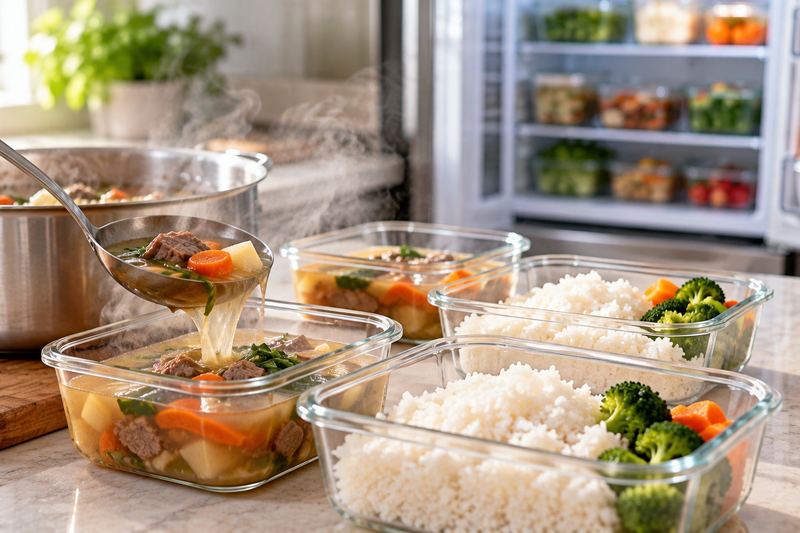
Reheat cooked rice until it's steaming hot all the way through and reaches 165°F (74°C). In the microwave, sprinkle a little water over the rice, cover it, heat it, stir, and heat again until it's hot throughout. On the stove, add a little water to a pan, cover, and stir over medium heat until steaming. Fried rice can be reheated in a skillet, stirring often, or in the microwave the same way.
How the rice was stored matters more than how you reheat it. Raw rice can contain spores of Bacillus cereus, a bacterium whose spores survive cooking, Food Standards Scotland explains. If cooked rice cools slowly or sits at room temperature, the spores can grow and produce a toxin. University of Florida IFAS Extension notes that this toxin is heat-stable, so reheating, even to 165°F, may not destroy it. That's why the safety steps happen before reheating:
- Cool it fast. Spread rice in a shallow container and refrigerate it within 2 hours (US rule); Food Standards Scotland advises within 1 hour if you can. See can you put hot food in the fridge.
- Store it cold. Keep it at 40°F (4°C) or below and use it within 3–4 days (US guidance; Food Standards Scotland is stricter at 24 hours).
- Reheat once. The UK Food Standards Agency and Food Standards Scotland both advise never reheating rice more than once.
What is reheated rice syndrome?
"Reheated rice syndrome" and "fried rice syndrome" aren't medical terms. They're popular names for food poisoning from Bacillus cereus in rice that was cooked, left to cool slowly, and then reheated. A CDC outbreak report notes that storing boiled rice at room temperature before frying it is the practice generally implicated, and that reheating can kill the bacteria while leaving the toxin. UF/IFAS describes two forms: a vomiting form that starts about 1–6 hours after eating, and a diarrheal form that starts about 6–15 hours after. Anyone with severe or lasting symptoms should contact a doctor.
How to reheat chicken, pizza, soup and other leftovers
Chicken
Reheat cooked chicken to 165°F (74°C) in the oven, a covered skillet or the microwave. Add a little broth or water and cover it to keep it from drying out; slice large pieces so the center heats through. Check the thickest piece with a thermometer.
Pizza
Reheat leftover pizza in the oven, a skillet, an air fryer or the microwave until the center of the topping reaches 165°F (74°C). Refrigerated pizza keeps 3–4 days.
Soups, stews, sauces and gravy
Bring them to a rolling boil, as FSIS recommends, stirring so the bottom doesn't scorch. Reheat only the portion you'll eat rather than reboiling the whole pot each time.
Casseroles and ham
Cover a casserole with foil and heat it in the oven until the center reads 165°F (74°C); casseroles take longer than you expect because the middle heats last. FoodSafety.gov says precooked ham packaged in a USDA-inspected plant only needs to reach 140°F (60°C); precooked ham that wasn't packaged in a USDA-inspected plant should reach 165°F.
Salmon, eggs and other leftovers
Cooked fish and egg dishes are leftovers like any other: reheat them to 165°F. Gentle, covered heat helps keep them from drying out (see how long to cook salmon for first-time cooking).
How many times can you reheat food?
For safety, it's best to reheat leftovers once, and only the amount you'll eat. FSIS's leftovers guidance doesn't set a number of reheats; it requires 165°F each time and use within 3–4 days. The UK Food Standards Agency is more specific: reheat cooked meat only once in the microwave, and never reheat rice more than once. Each cycle of cooling and reheating adds time in the danger zone, 40°F to 140°F (4°C to 60°C), so dividing leftovers into single portions before you refrigerate them is the simplest fix.
Does reheating food kill bacteria?
Reheating to 165°F is the safety standard for leftovers, but it doesn't make spoiled or mishandled food safe. Nebraska Extension notes that some bacteria, such as Staphylococcus aureus, form toxins that cooking can't destroy. Food that sat out more than 2 hours (1 hour above 90°F) should be discarded, not reheated (see how long food can sit out).
How to reheat frozen leftovers
You can reheat frozen leftovers without thawing them, FSIS says: soups and stews in a saucepan or microwave, casseroles in the oven or microwave. It just takes longer. If you'd rather thaw first, use the fridge, cold water or the microwave, never the counter (see thawing). Food thawed in the microwave should be heated to 165°F right away.
Frozen leftovers stay safe indefinitely at 0°F (−18°C) and keep best quality for 3–4 months. Once reheated to 165°F, any remaining portion of previously frozen leftovers can be refrozen, per FSIS.
Questions people ask
What temperature should leftovers be reheated to?
165°F (74°C), measured with a food thermometer. Bring soups, sauces and gravy to a rolling boil.
Can you reheat rice?
Yes, if it was cooled quickly and refrigerated within 2 hours. Reheat it until steaming hot throughout (165°F), and UK agencies advise doing so only once.
Can you reheat food twice?
US guidance doesn't set a limit as long as food reaches 165°F each time and is eaten within 3–4 days, but reheating only what you'll eat is safer. UK guidance says once for rice and for cooked meat in the microwave.
Why let microwaved food stand before eating?
Standing time lets heat spread into cold spots. FSIS advises letting food rest before checking its final temperature.
How long are leftovers good for?
3–4 days in the fridge at 40°F or below, or 3–4 months frozen for best quality.
Sources
- USDA FSIS: Leftovers and food safety
- FoodSafety.gov: Safe minimum internal temperatures
- Clemson Cooperative Extension: Microwave food safety
- University of Florida IFAS Extension: Preventing foodborne illness: Bacillus cereus
- Food Standards Scotland: Rice
- UK Food Standards Agency: Not reheating leftovers until steaming hot throughout
- CDC MMWR: Bacillus cereus, Maine
- Nebraska Extension: Will reheating food make it safe if you forget to refrigerate it?