Yes, you can put hot food in the fridge. USDA FSIS says hot food can go straight into the refrigerator, and it must be refrigerated within 2 hours of cooking (1 hour above 90°F). To cool it fast, divide large batches into shallow containers, cut big pieces smaller, or chill the pot in an ice-water bath first.
Key facts
- FSIS: hot food can go directly into the fridge; you don't need to cool it on the counter first.
- Refrigerate cooked food within 2 hours, or 1 hour when the room or outdoor temperature is above 90°F (32°C).
- Shallow containers, smaller portions and an ice-water bath all speed cooling.
- Home rule: keep hot food at 140°F (60°C) or above until you chill it.
- Restaurant rule (FDA Food Code): cool from 135°F to 70°F within 2 hours, then to 41°F or below within the next 4 hours.
Can you put hot food in the fridge?
Yes. USDA's Food Safety and Inspection Service (FSIS) says hot food can be placed directly in the refrigerator, or chilled quickly in an ice or cold-water bath and then refrigerated. There's no food safety reason to wait for food to reach room temperature. Waiting is the riskier choice, because cooling food passes through the danger zone, 40°F to 140°F (4°C to 60°C), where bacteria multiply fastest.
The real limit is time. FSIS says leftovers must be refrigerated within 2 hours of cooking, or within 2 hours of taking them off a warming tray or slow cooker. When it's hotter than 90°F (32°C), such as at a picnic, the limit is 1 hour. Food left out longer should be thrown out (see how long food can sit out).
Is it bad to put warm food in the fridge?
No, it's not bad for the food, and it's the safe thing to do. Warm food in the fridge is the goal; warm food on the counter for hours is the problem. The thing to manage is volume. A deep stockpot of chili or a whole roast holds a lot of heat, and its center can stay warm for a long time even in a cold fridge. That's why FSIS tells you to divide large amounts into shallow containers rather than refrigerate one big pot.
A few habits help the fridge do its job:
- Leave space around containers. University of Florida IFAS Extension advises against stacking containers while food cools, so cold air can circulate around them.
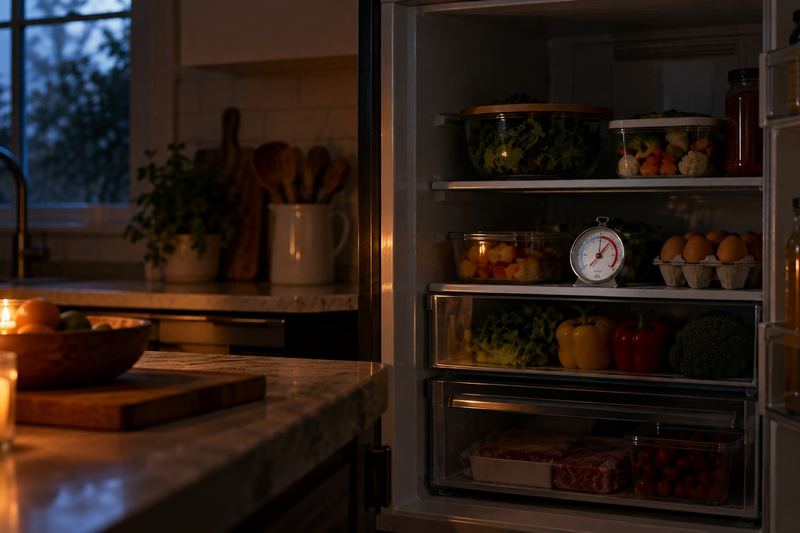
- Keep the fridge at 40°F (4°C) or below. An appliance thermometer tells you if a big load of warm food has pushed it up (see what temperature a refrigerator should be).
- Use a container for each batch. Several small, shallow containers chill faster than one deep one and are easier to reheat one portion at a time.
How to cool food properly and fast
To cool cooked food quickly, increase its surface area and get it cold from the outside. These are the methods FSIS lists for home cooks and FDA lists for food workers.
- Use shallow containers. Spread food in a thin layer instead of leaving it in a deep pot. Thin layers lose heat much faster.
- Divide large batches. Split a big pot of soup, stew, beans or sauce into several smaller containers.
- Cut large items into smaller pieces. FSIS says to cut large items into smaller portions. For example, slice a roast or take turkey meat off the bone before refrigerating.
- Use an ice-water bath. Set the pot or container in a sink or larger bowl of ice water and stir the food. FDA lists stirring food in a container placed in an ice-water bath as a standard cooling method.
- Refrigerate within 2 hours, even if the food is still warm. Don't wait for it to cool completely.
How to cool rice quickly
Spread freshly cooked rice in a thin layer on a tray or in a shallow container, then refrigerate it. Rice needs fast cooling because it can carry spores of Bacillus cereus, which survive cooking. If the rice cools slowly or sits out, the bacteria can grow and form a toxin that reheating won't destroy, according to University of Florida IFAS Extension. Food Standards Scotland advises chilling cooked rice ideally within 1 hour; the US limit for all perishable food is 2 hours. Refrigerated cooked rice keeps 3–4 days (see cooked rice), and how to reheat leftovers covers reheating it.
Cooling meat, soups and stews
Slice or shred cooked meat before refrigerating it, and pour soups and stews into shallow containers or cool them in an ice bath while stirring. Cooked meat and poultry keep 3–4 days in the fridge, as do soups and stews (see soup and leftovers). If you won't eat them in that time, freeze them once they're cold.
What is the FDA two-stage cooling rule?
FDA's model Food Code, written for restaurants and other food businesses, requires cooked food to cool in two stages:
| Stage | From | To | Time limit |
|---|---|---|---|
| Stage 1 | 135°F (57°C) | 70°F (21°C) | Within 2 hours |
| Stage 2 | 70°F (21°C) | 41°F (5°C) or below | Within the next 4 hours |
| Total | 135°F (57°C) | 41°F (5°C) or below | 6 hours at most |
The first stage is the strict one because bacteria grow fastest in the warmer part of the range. FDA's guidance for food employees says that if food reaches 70°F in less than 2 hours, the remaining time carries over to the second stage. Restaurants check this with a thermometer and a cooling log. Home cooks don't need a log, but the same methods (shallow pans, small portions, ice baths) are what make the timeline achievable.
What temperature should hot food be kept at?
Keep hot food at 140°F (60°C) or above until it's served or refrigerated, according to USDA FSIS. Use chafing dishes, warming trays or a slow cooker on a warm setting, and check the food itself with a food thermometer, not just the appliance dial (see how to use a meat thermometer).
| Rule | Home (USDA FSIS) | Food businesses (FDA Food Code) |
|---|---|---|
| Hot holding | 140°F (60°C) or above | 135°F (57°C) or above |
| Cold holding | 40°F (4°C) or below | 41°F (5°C) or below |
| Danger zone | 40–140°F (4–60°C) | 41–135°F (5–57°C) |
At home, follow the FSIS numbers: use 140°F for holding and 165°F for reheating leftovers and casseroles. To convert any reading, use the temperature converter.
Questions people ask
Should you let food cool before putting it in the fridge?
No. USDA FSIS says hot food can go directly into the refrigerator. Just get it there within 2 hours of cooking, or 1 hour above 90°F.
Is it dangerous to put hot food in the refrigerator?
No. The bigger risk is leaving food out to cool, which keeps it in the 40–140°F danger zone. Use shallow containers so large batches chill quickly.
Can I put a whole pot of soup in the fridge?
It's better to divide it. A full pot cools slowly in the middle, so pour it into shallow containers or chill it in an ice-water bath first, stirring as it cools.
How long can hot food sit out before refrigerating?
No more than 2 hours, or 1 hour if the air is above 90°F. After that, FSIS says to discard it.
What's the fastest way to cool rice?
Spread it in a thin layer in a shallow container or on a tray and refrigerate it right away. Food Standards Scotland advises chilling cooked rice ideally within 1 hour.
Sources
- USDA FSIS: Leftovers and food safety
- FDA: Cooling cooked time/temperature control for safety foods and the FDA Food Code (for food employees)
- University of Florida IFAS Extension: Preventing foodborne illness: Bacillus cereus
- Food Standards Scotland: Rice
- FoodSafety.gov: Cold food storage chart
- FoodSafety.gov: Safe minimum internal temperatures