A US cup holds 236.6 mL. The metric cup used in Canada and Australia holds 250 mL, about 6% more. US nutrition labels use a third size, a 240 mL "legal" cup set by the FDA. For most cooking the gap is too small to matter, but for baking, convert to grams or milliliters to be exact.
Key facts
- US customary cup: 236.6 mL, equal to 8 US fluid ounces or 16 tablespoons (NIST).
- FDA nutrition-labeling cup: 240 mL, with 1 tbsp = 15 mL, 1 tsp = 5 mL and 1 fl oz = 30 mL (21 CFR 101.9).
- Metric cup: 250 mL, the size Health Canada and Australia's dietary guidelines use.
- Imperial (UK) pint: 568.3 mL, about 20% larger than the 473.2 mL US pint. The imperial gallon is about 20% larger too.
- An imperial fluid ounce (28.41 mL) is about 4% smaller than a US fluid ounce (29.57 mL).
How many mL is a US cup?
The US customary cup is 236.5882 mL, which rounds to 236.6 mL. That figure comes from NIST Special Publication 811, the federal reference for unit conversions. The rest of the US kitchen system builds on it:
- 1 cup = 8 US fluid ounces (1 fl oz = 29.57 mL)
- 1 cup = 16 tablespoons (1 tbsp = 14.79 mL)
- 1 tablespoon = 3 teaspoons (1 tsp = 4.93 mL)
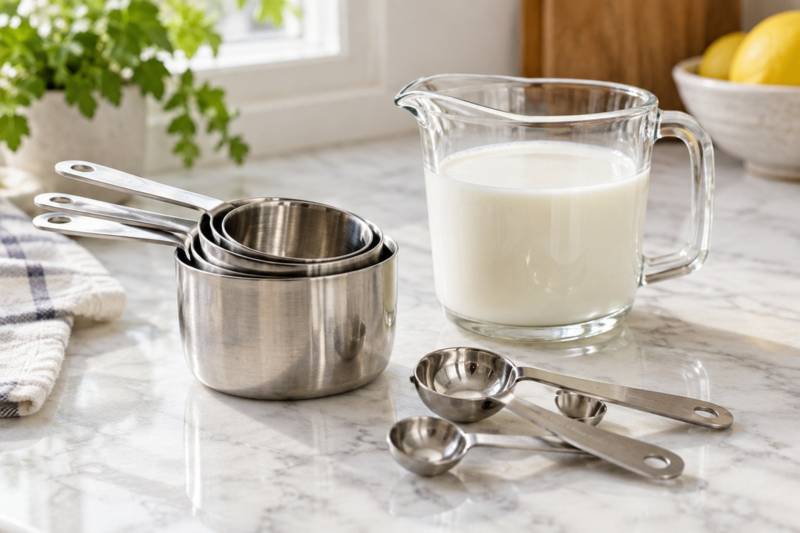
Measuring cups and spoons sold in the US, and recipes written by US cooks, use these sizes. For quick lookups, see mL in a cup, mL in a tablespoon and mL in a teaspoon.
What is the 240 mL "legal" cup?
The FDA's nutrition labeling rule (21 CFR 101.9) rounds household measures to tidy metric numbers. For nutrition labels, a cup means 240 mL, a tablespoon 15 mL, a teaspoon 5 mL, a fluid ounce 30 mL and an ounce of weight 28 g. NIST's table of approximate US-to-metric conversions also lists a cup as 240 mL.
So when a yogurt or juice label lists a serving as "1 cup (240 mL)," that's the labeling cup, not a different set of measuring cups. The 240 mL figure is only 1.4% larger than the true US cup, a difference you can't see in a measuring cup. In your kitchen, a US cup is still 236.6 mL.
What is a metric cup?
A metric cup is 250 mL. It isn't an official SI unit, just a convenient kitchen measure that fits neatly into a liter: four metric cups make 1 liter.
- Canada: Health Canada's food guide pairs 250 mL with 1 cup, 125 mL with 1/2 cup, 60 mL with 1/4 cup, 15 mL with 1 tablespoon and 5 mL with 1 teaspoon. Canadian recipes and measuring cups often show both metric and cup markings.
- Australia: the Australian Dietary Guidelines describe a standard serve of milk as 1 cup (250 mL).
A metric cup holds about 13.4 mL more than a US cup, a little less than one extra US tablespoon. That's roughly 5.7% more volume.
US vs metric vs labeling cups compared
| Cup | Volume | In US cups | Where you'll see it |
|---|---|---|---|
| US customary cup | 236.6 mL | 1 | US recipes and measuring cups |
| US labeling ("legal") cup | 240 mL | 1.01 | US Nutrition Facts labels |
| Metric cup | 250 mL | 1.06 | Canada, Australia |
US vs imperial pints, gallons and fluid ounces
The bigger trap isn't the cup. It's the pint and the gallon. The US and the UK both use pints, quarts, gallons and fluid ounces, but the units are different sizes. NIST lists both systems, and the UK's Weights and Measures Act 1985 defines the imperial units.
| Unit | US | Imperial (UK) | Difference |
|---|---|---|---|
| Fluid ounce | 29.57 mL | 28.41 mL | Imperial is about 4% smaller |
| Pint | 473.2 mL (16 US fl oz) | 568.3 mL (20 imperial fl oz) | Imperial is about 20% larger |
| Quart | 946.4 mL | 1,136.5 mL (1/4 gallon) | Imperial is about 20% larger |
| Gallon | 3,785 mL (3.785 L) | 4,546 mL (4.546 L) | Imperial is about 20% larger |
Two things cause the mismatch. The imperial fluid ounce is slightly smaller, but an imperial pint holds 20 of them instead of 16. The result: an imperial pint is about 2.4 US cups, not 2. If a British recipe calls for "1 pint" of milk and you pour 2 US cups, you're about 95 mL short.
The US also has a separate dry pint (550.6 mL) and dry quart (1,101 mL) for produce like berries. Recipes that list a pint of cream or stock mean the liquid pint. See cups in a pint, ounces in a pint, ounces in a gallon and cups in a gallon for the US figures.
How do you convert a recipe between US and metric cups?
Most recipes: swap cup for cup
For soups, stews, sauces, rice and most savory cooking, a 6% difference in cup size won't change the result. The ratios between ingredients stay the same as long as you use one set of cups for the whole recipe. Don't mix a metric cup of liquid with US cups of everything else.
Baking: convert to weight or milliliters
Baking is less forgiving because the balance of flour, liquid, fat and leavening matters. If a recipe gives grams or milliliters, use those. If it gives only cups, figure out which cup the writer meant (Canadian and Australian sources usually mean 250 mL) and convert:
| Metric recipe says | Volume | In US measures (approx.) |
|---|---|---|
| 1 cup | 250 mL | 1 US cup + 1 scant tablespoon |
| 1/2 cup | 125 mL | 1/2 US cup + 1/2 tablespoon |
| 1/4 cup | 60 mL | 1/4 US cup |
| 4 cups | 1 L | 4 US cups + about 3 1/2 tablespoons (4.23 US cups) |
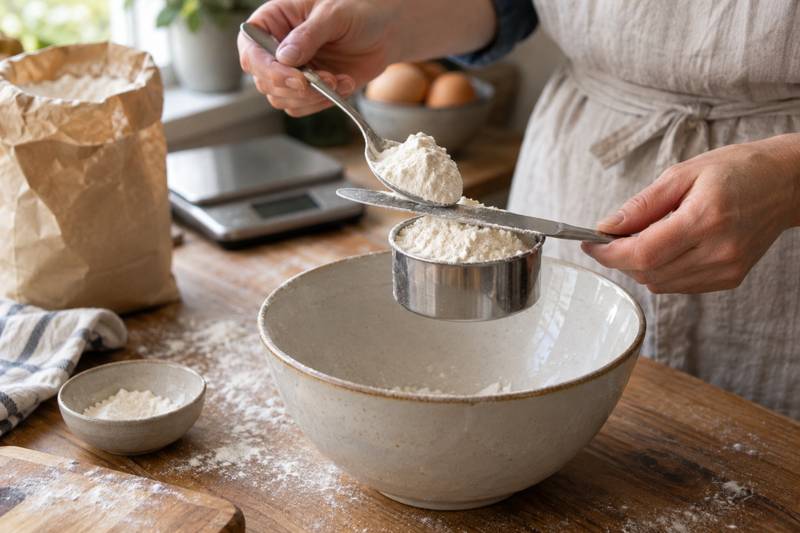
For dry ingredients, weight is more reliable than any cup. A cup of all-purpose flour weighs about 120 g spooned and leveled in a US cup, according to King Arthur Baking, but how you fill the cup changes the weight more than the cup size does. The cups to grams pages give US-cup weights for common ingredients, and how to measure flour covers technique.
Imperial recipes: watch pints and fluid ounces
If a recipe lists liquids in imperial pints or fluid ounces, convert to milliliters first, then to US measures: 1 imperial pint = 568 mL, about 2 1/3 US cups plus 1 tablespoon (2.4 US cups). Half an imperial pint is 284 mL, about 1 1/5 US cups. Our measurement converter and cups in a liter page help with the second step.
Questions people ask
Is a cup 240 mL or 250 mL?
Neither, in a US kitchen: a US cup is 236.6 mL. 240 mL is the FDA's rounded labeling cup, and 250 mL is the metric cup used in Canada and Australia.
Can I use US measuring cups for a Canadian or Australian recipe?
For most cooking, yes, as long as you use them for every ingredient. For baking, use the recipe's grams or milliliters if they're given, since a metric cup is about 6% larger.
Is a UK pint bigger than a US pint?
Yes. An imperial pint is 568.3 mL and a US pint is 473.2 mL, so the UK pint is about 20% larger.
Is a UK fluid ounce the same as a US fluid ounce?
No. An imperial fluid ounce is 28.41 mL and a US fluid ounce is 29.57 mL, about 4% bigger.
How many US cups are in a liter?
About 4.23. A liter is exactly 4 metric cups of 250 mL.
Sources
- NIST: SP 811 Appendix B.9, conversion factors
- NIST: Approximate conversions from U.S. customary measures to metric
- eCFR: 21 CFR 101.9, nutrition labeling of food
- Health Canada: Measure ingredients like a pro
- Australian Bureau of Statistics: Milk, yoghurt, cheese and alternatives (Australian Health Survey)
- UK legislation: Weights and Measures Act 1985, Schedule 1
- King Arthur Baking: How to measure flour the right way