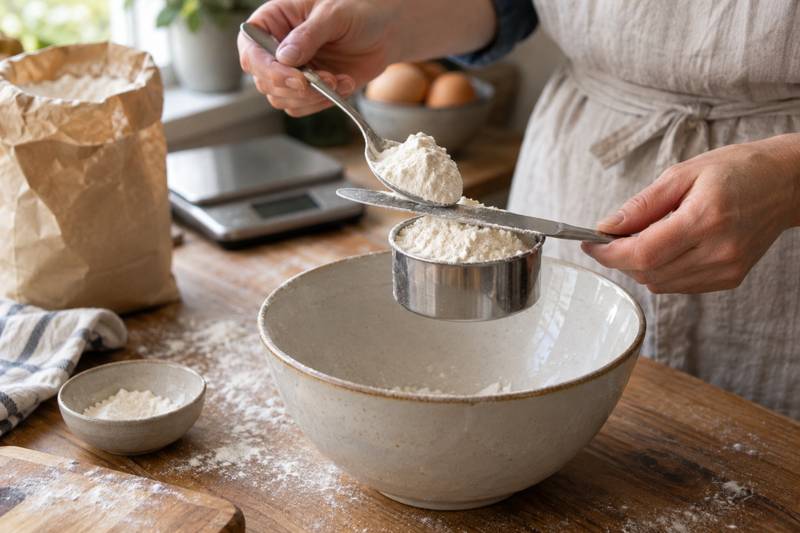
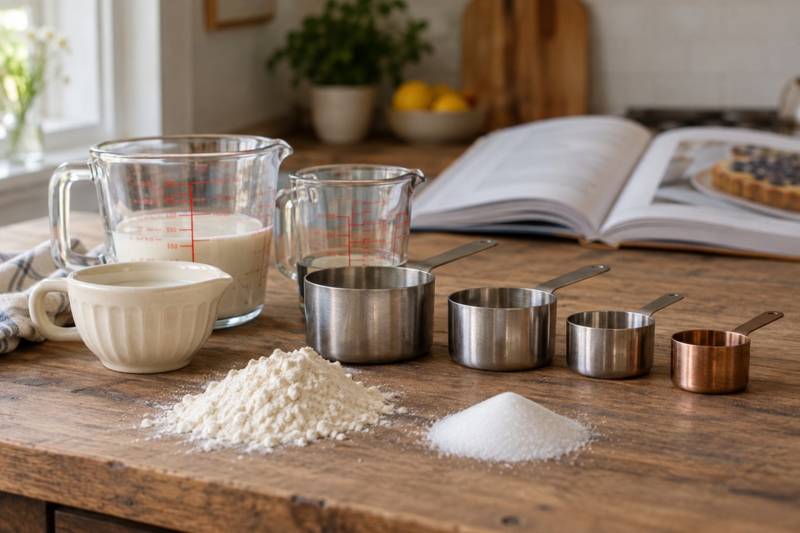
Dry and liquid measuring cups hold the same US cup: 236.6 mL, or 8 fluid ounces. The difference is technique. Dry cups are filled to the rim and leveled, which suits flour and sugar. Liquid cups have a spout and room above the line, so you can fill to a mark and read it at eye level without spilling.
Key facts
- 1 US cup = 8 fl oz = 16 tbsp = 236.6 mL, whichever style of cup you use (NIST).
- Dry cups come in nested sizes, usually 1/4, 1/3, 1/2 and 1 cup, and are leveled at the rim.
- Liquid cups are clear, with a spout and markings below the rim; read them on a flat counter with your eye at the line.
- A fluid ounce measures volume; an ounce (sometimes called a "dry ounce") measures weight, 28.35 g.
- How many tablespoons are in an ounce of a dry ingredient depends on the ingredient: about 2.3 for granulated sugar, about 3.8 for flour.
What is the difference between dry and liquid measuring cups?
Dry measuring cups are sold as nested sets. Each cup holds exactly its stated amount when filled to the rim. Kansas State Research and Extension lists the standard set as 1/4, 1/3, 1/2 and 1 cup, and Mississippi State University Extension notes that some sets add 1/8 and 2/3 cup. Because the rim is the measurement, you can sweep a knife across it to level flour, sugar or shortening.
Liquid measuring cups are usually clear glass or plastic, with a spout and graduated lines printed on the side. The top line sits below the rim. That extra space lets you carry a full cup of milk without spilling, and the spout lets you pour cleanly. They come in 1-cup, 2-cup and 4-cup sizes, often with metric markings too.
Do dry and liquid measuring cups hold the same amount?
Yes. Both are built around the same US customary cup: 236.6 mL, 8 US fluid ounces or 16 tablespoons. A dry 1-cup measure filled to the rim and a liquid cup filled to the 1-cup line hold the same volume. What changes is how accurately you can fill each one.
Why does using the right cup matter?
Each cup is designed so the most accurate fill is also the easiest one.
- Liquid in a dry cup: you have to fill it to the very brim. North Dakota State University Extension points out that a brim-full cup spills easily on the way to the bowl, and you end up with less than you measured.
- Flour in a liquid cup: there's no rim at the 1-cup line to level against. You end up shaking or tapping the cup to flatten the flour, which packs it. Health Canada says a packed cup of flour holds more than the recipe needs.
- Thick ingredients: Health Canada recommends dry cups for yogurt, cottage cheese and nut butter, because thick foods cling to the sides of a liquid cup and don't fully pour out.
For one cup of water in a soup, small differences won't matter. For baking, where flour, liquid and leavening have to balance, they can. See how to measure flour for the full spoon-and-level method.
How do you read a liquid measuring cup correctly?
- Set the cup on a flat counter. Holding it in your hand tilts the surface of the liquid.
- Pour to the line. Use the smallest cup that fits. Health Canada's example: measure 60 mL (1/4 cup) of water in a 1-cup (250 mL) measure, not a 1-liter one, because the lines are farther apart and easier to read.
- Bend down until your eye is level with the mark. Looking from above makes the liquid appear higher than it is, so you under-pour.
- Read the bottom of the curve. Water and milk curve slightly where they meet the side of the cup. University of Wisconsin–Madison Extension advises checking the bottom edge of the liquid against the mark.
For sticky liquids like honey or molasses, the challenge is getting it all out rather than reading the line. Scrape the cup with a spatula, or weigh them instead (see honey cups to grams).
Liquid measurements: US equivalents
These are the standard US kitchen equivalents. They apply to any liquid by volume, and to dry ingredients measured by volume too.
| Measure | Tablespoons | Teaspoons | Fluid ounces | Milliliters |
|---|---|---|---|---|
| 1 teaspoon | 1/3 | 1 | 0.1667 | 4.929 |
| 1 tablespoon | 1 | 3 | 1/2 | 14.79 |
| 1/8 cup | 2 | 6 | 1 | 29.57 |
| 1/4 cup | 4 | 12 | 2 | 59.15 |
| 1/3 cup | 5 1/3 | 16 | 2 2/3 | 78.86 |
| 1/2 cup | 8 | 24 | 4 | 118.3 |
| 2/3 cup | 10 2/3 | 32 | 5 1/3 | 157.7 |
| 3/4 cup | 12 | 36 | 6 | 177.4 |
| 1 cup | 16 | 48 | 8 | 236.6 |
| 1 pint | 32 | 96 | 16 | 473.2 |
| 1 quart | 64 | 192 | 32 | 946.4 |
| 1 gallon | 256 | 768 | 128 | 3,785 |
US customary units, exact NIST factors. Milliliters rounded to 4 significant figures; nutrition labels round a cup to 240 mL.
The quick rules: 3 teaspoons = 1 tablespoon, 2 tablespoons = 1 fluid ounce, 16 tablespoons = 1 cup, 2 cups = 1 pint, 2 pints = 1 quart and 4 quarts = 1 gallon. For single conversions, see ounces in a cup, cups in a quart, mL in a cup and tablespoons in an ounce, or use the measurement converter.
What is a dry ounce?
"Dry ounce" isn't a separate unit. It's an informal name for the ordinary ounce of weight (the avoirdupois ounce), which NIST defines as 28.35 g. Sixteen of them make a pound. A fluid ounce is a unit of volume: 29.57 mL, or 1/8 of a cup.
The two only line up for water and liquids of similar density. A fluid ounce of water weighs close to an ounce. A fluid ounce of honey weighs more, and a fluid ounce of flour weighs much less. That's why a recipe that lists "8 oz chocolate" wants you to weigh it, while "8 fl oz milk" means 1 cup by volume.
How many tablespoons are in a dry ounce?
It depends on what you're measuring, because a tablespoon is volume and an ounce is weight. Using the cup weights on this site (1 tablespoon = 1/16 cup, 1 oz = 28.35 g):
| Ingredient | Grams per tablespoon | Tablespoons per ounce | Teaspoons per ounce |
|---|---|---|---|
| All-purpose flour | 7.5 g | about 3.8 | about 11 |
| Granulated sugar | 12.5 g | about 2.3 | about 7 |
| Brown sugar, packed | 13.75 g | about 2.1 | about 6 |
| Butter | 14.2 g | 2 | 6 |
| Cocoa powder | 5.4 g | about 5.3 | about 16 |
| Table salt | 18.25 g | about 1.6 | about 4.7 |
| Water (for comparison) | 14.8 g | about 1.9 | about 6 |
Going the other way, "how many dry ounces in a tablespoon" is the same math flipped: a tablespoon of flour weighs about 0.26 oz, and a tablespoon of granulated sugar about 0.44 oz. For an exact amount, weigh it. See grams in a tablespoon and grams in an ounce.
How do you convert dry ounces to pints?
You can't without knowing the ingredient. Ounces of weight tell you how heavy something is; pints tell you how much space it fills. Convert the weight to grams, divide by the ingredient's grams per cup, then divide by 2 (2 cups per US pint). For example, 16 oz (453.6 g) of granulated sugar is about 2.3 cups, or roughly 1.1 pints.
One more wrinkle: the US also has a dry pint, a separate volume unit for things like berries. NIST lists it at 550.6 mL, compared with 473.2 mL for the US liquid pint. A recipe that says "1 pint" of milk or cream means the liquid pint, 2 cups. See cups in a pint and ounces in a pint.
Questions people ask
Can I use a dry measuring cup for liquids?
You can, since it holds the same volume, but you have to fill it to the brim, which makes spills and short measures likely. A liquid cup with a spout is more accurate for milk, water and oil.
Is a fluid ounce the same as an ounce?
No. A fluid ounce is volume (29.57 mL); an ounce is weight (28.35 g). They come close only for water and liquids with a similar density.
How many tablespoons are in a dry ounce?
It depends on the ingredient: about 3.8 for all-purpose flour, about 2.3 for granulated sugar and 2 for butter. Weigh the ingredient if the recipe gives ounces.
Why does my liquid measure look different from above?
Looking down at an angle makes the liquid line look higher than it is. Set the cup on the counter and bend down so your eye is level with the mark.
Should I measure sour cream or peanut butter in a dry or liquid cup?
Use a dry cup. Thick foods stick to the sides of a liquid cup, so press them into a dry cup, level the top and scrape it out with a spatula.
Sources
- NIST: SP 811 Appendix B.9, conversion factors
- Health Canada: Measure ingredients like a pro
- NDSU Extension: Kitchen Equipment and Recipes (FN1812)
- K-State Research and Extension: Cooking Basics: Measuring Tools and How to Use Them (MF3518)
- Mississippi State University Extension: Measuring dry or solid ingredients
- University of Wisconsin–Madison Extension, Clark County: Helpful tips for measuring ingredients
- King Arthur Baking: Ingredient weight chart
- USDA FoodData Central: Sugars, granulated (FDC 169655)