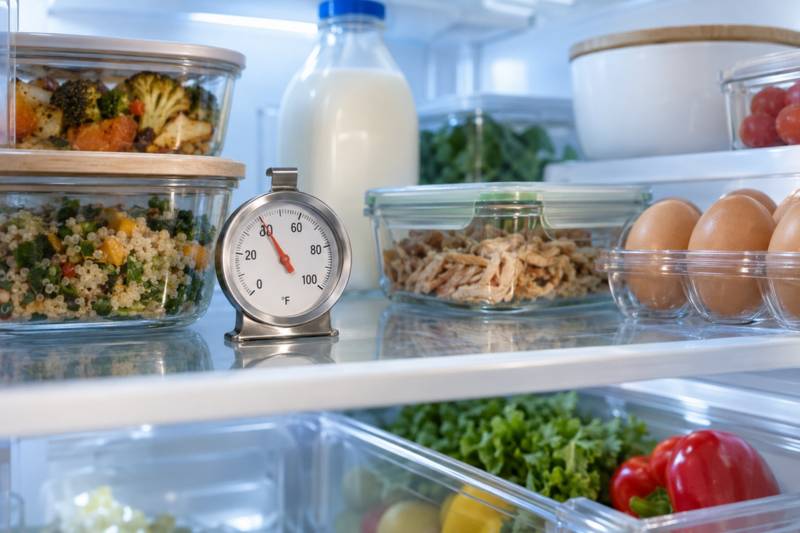
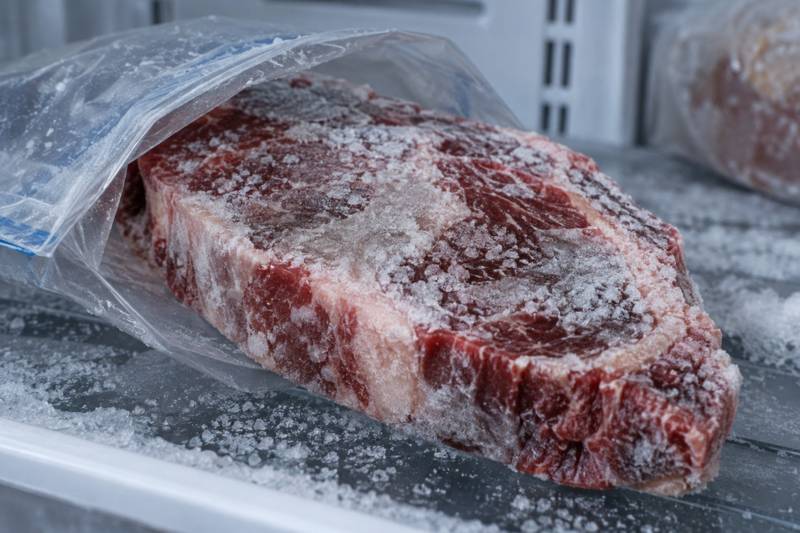
The best way to freeze meat is to freeze it fresh, within its fridge time, in airtight freezer packaging with the air pressed out, in flat meal-size portions spread in one layer, at 0°F or below. Label each package with the date. Frozen meat stays safe indefinitely; freezer times such as 3–4 months for ground beef are for quality.
Key facts
- Keep the freezer at 0°F (-18°C) or below; food held there stays safe indefinitely.
- Freezing doesn't kill bacteria; it makes them inactive until the food thaws.
- It's safe to freeze meat in its store package, but overwrap it for longer storage because that wrap lets air through.
- Best quality: ground meat 3–4 months, steaks and chops 4–12 months, poultry parts 9 months, deli meat 1–2 months, bacon 1 month.
- Freeze no more than about 2 to 3 lb of unfrozen food per cubic foot of freezer space in 24 hours (NDSU Extension).
The best way to freeze meat
Good freezing is about two things: keeping meat safe before it goes in, and keeping air and warmth away once it's there. Freezing to 0°F stops bacteria, yeasts and molds from growing, but USDA notes it doesn't destroy them. They become active again as the meat thaws, so the meat you freeze should be as fresh as the meat you'd cook today.
- Freeze within the fridge window. Raw ground meat, poultry, sausage and fish keep only 1 to 2 days in the fridge; steaks, chops and roasts 3 to 5 days. Freeze them within that time, ideally right after shopping. See our food storage charts for each cut.
- Freeze fast. Fast freezing forms small ice crystals that do less damage to texture. Slow freezing makes large crystals that cause meat to drip when it thaws. FSIS says a 2-inch-thick package should ideally freeze solid in about 2 hours.
- Keep the freezer at 0°F. Check it with an appliance thermometer. Our refrigerator and freezer temperature guide explains how.
How to package meat for the freezer
Packaging is where most quality is won or lost. Air reaching the meat's surface dries it out and causes freezer burn.
Store packaging
FSIS says freezing meat and poultry in the original package is safe. The thin plastic over a supermarket tray lets air through, though, so for anything you won't use soon, overwrap the package with heavy-duty foil, freezer paper or a freezer bag. Unopened vacuum-sealed packages from the store can go into the freezer as they are. If a package tears in the freezer, the meat is still safe; just rewrap it.
Wrapping meat yourself
Use materials made for the freezer: butcher or freezer wrap, heavy-duty aluminum foil, or freezer bags, as Penn State Extension recommends. NDSU Extension advises packaging that's moisture- and vapor-resistant and stays flexible in the cold. Wrap tightly so the material touches the meat, press out as much air as possible from bags, and make sure there are no gaps or tears. Penn State Extension also suggests removing bones where practical, since they take up space and can puncture the wrap.
Portion, freeze flat and don't stack
Divide meat into the amounts you'll cook at one time before freezing. That way you thaw only what you need and avoid the quality loss of refreezing thawed meat.
- Ground meat: press it into a thin, flat layer in a freezer bag before sealing. Flat packages freeze faster and thaw faster.
- Chicken parts, chops and steaks: freeze pieces individually or in single layers so they freeze quickly and separate easily.
- Large roasts: cut big cuts into manageable portions before wrapping.
Lay new packages in a single layer with space around them; FSIS says not to stack packages until they're frozen solid. NDSU Extension recommends adding only as much unfrozen food as will freeze within 24 hours, roughly 2 to 3 lb per cubic foot of freezer space, so a big shopping haul may need to go in over two days while the rest waits in the fridge.
Label and date every package
Write the type of meat, the cut or amount, and the date you froze it on every package, using freezer tape, freezer labels or a marker that works in the cold. Frozen meat stays safe, but quality slips with time, and an unlabeled gray package is easy to forget. Put new packages behind older ones and use the oldest first.
How long can you freeze meat?
At a steady 0°F, frozen meat is safe indefinitely. The times below are for best quality, from FoodSafety.gov and USDA FSIS charts. After that, meat is still safe to eat but may be drier and less flavorful.
| Meat | Freezer time for best quality |
|---|---|
| Ground beef, pork, turkey or other ground meat | 3–4 months |
| Steaks and chops (beef, pork, veal, lamb) | 4–12 months |
| Roasts (beef, pork, veal, lamb) | 4–12 months |
| Whole chicken or turkey | 1 year |
| Chicken or turkey parts | 9 months |
| Raw sausage | 1–2 months |
| Bacon | 1 month |
| Hot dogs and lunch meat | 1–2 months |
| Lean fish (cod, haddock, sole) | 6–8 months |
| Fatty fish (salmon, tuna) | 2–3 months |
| Cooked meat | 2–3 months |
| Cooked poultry | 4 months |
For other foods, here are fridge and freezer times side by side:
| Food | Fridge (40°F) | Freezer (0°F) |
|---|---|---|
| Raw chicken | 1–2 days | 9–12 months |
| Cooked chicken | 3–4 days | 4 months |
| Raw ground beef | 1–2 days | 3–4 months |
| Raw steak | 3–5 days | 4–12 months |
| Raw bacon | 7 days | 1 month |
| Deli meat & lunch meat | 3–5 days | 1–2 months |
| Raw fish (lean, e.g. cod) | 1–2 days | 6–8 months |
| Raw eggs in the shell | 3–5 weeks | — |
| Hard-boiled eggs | 1 week | — |
| Milk | 7 days | 1–3 months |
| Leftovers (general) | 3–4 days | 3–4 months |
| Soup & stew | 3–4 days | 2–3 months |
| Cooked rice | 3–4 days | 2 months |
Specific pages: ground beef, raw chicken, steak.
Can you freeze lunch meat and deli meat?
Yes. FoodSafety.gov lists luncheon meat at 1 to 2 months in the freezer for best quality, whether the package is opened, deli-sliced or unopened. In the fridge, opened or deli-sliced lunch meat keeps only 3 to 5 days, so freezing is a good way to save what you won't finish.
- Freeze it soon after opening, not at the end of its fridge time.
- Divide slices into sandwich-size portions, wrap tightly and press air out of the bag.
- Thaw in the refrigerator and use within the fridge time for opened deli meat.
FoodSafety.gov advises pregnant people to reheat hot dogs, lunch meat and other deli meats to 165°F or until steaming hot before eating, because these foods can carry Listeria. Freezing doesn't change that advice. See how long deli meat lasts.
Can you freeze bacon, hot dogs and sausage?
Yes. Raw bacon is best within 1 month in the freezer, and hot dogs and raw sausage within 1 to 2 months. Unopened packages can go in as they are; overwrap them in a freezer bag for extra protection. See our pages on bacon and raw sausage.
How to freeze cooked meat and leftovers
Cool cooked meat quickly. FSIS says to divide large amounts into shallow containers and cut big items, such as a roast or turkey, into smaller portions; hot food can go straight into the fridge. Refrigerate leftovers within 2 hours of cooking (1 hour above 90°F) and freeze them within 3 to 4 days.
Pack cooked meat in airtight containers or freezer bags with little air space. Frozen leftovers are best within 3 to 4 months, according to FSIS. Reheat to 165°F; frozen soups, stews and casseroles can go straight from the freezer to the pan, microwave or oven. More on our leftovers storage page.
Is vacuum sealing worth it for freezing meat?
Vacuum sealing is one of the most effective ways to remove air, which is the main cause of freezer burn. Iowa State University Extension lists it alongside pressing air out of freezer bags as a way to protect frozen food. Removing oxygen also helps keep fats from turning rancid, notes Clemson Cooperative Extension.
Vacuum sealing doesn't make meat shelf-stable. Clemson Extension warns that some harmful bacteria grow well in low-oxygen packages, so vacuum-sealed raw meat must still be refrigerated or frozen, and thawed vacuum-packed food should never sit at room temperature. A tightly wrapped freezer bag with the air pressed out works well too.
Thawing and refreezing frozen meat
Thaw meat in the refrigerator, in cold water changed every 30 minutes, or in the microwave, never on the counter. Meat thawed in cold water or the microwave should be cooked right away. You can also cook meat straight from frozen; it takes about 50% longer. Our thawing guides have times for each cut.
Meat thawed in the fridge can be refrozen without cooking, with some loss of quality. Meat thawed in cold water or the microwave needs to be cooked before it goes back in the freezer.
Questions people ask
Can you freeze deli meat?
Yes. Lunch meat keeps its best quality for 1 to 2 months in the freezer. Freeze it in small, tightly wrapped portions soon after opening and thaw it in the fridge.
How long can you freeze hamburger meat?
Raw ground beef is best within 3 to 4 months at 0°F. It stays safe longer, but it may be drier and less flavorful.
How long can you freeze meat?
Indefinitely for safety at 0°F. For quality, plan on 3 to 4 months for ground meat, 4 to 12 months for steaks, chops and roasts, and 9 months to 1 year for chicken and turkey.
Can you freeze meat in the store packaging?
Yes, it's safe. For storage beyond a short while, overwrap the package with foil, freezer paper or a freezer bag, because the store wrap lets air through.
Can you refreeze meat?
Yes, if it thawed in the refrigerator. Meat thawed in cold water or the microwave should be cooked first, and meat left out more than 2 hours shouldn't be refrozen.
Can you freeze sandwich meat that's already opened?
Yes. Freeze opened sandwich meat within its 3- to 5-day fridge window, wrapped airtight in portions, and use it within 1 to 2 months for best quality.
Sources
- USDA FSIS: Freezing and Food Safety
- FoodSafety.gov: Cold Food Storage Charts
- USDA FSIS: Leftovers and Food Safety
- USDA FSIS: The Big Thaw: Safe Defrosting Methods
- Penn State Extension: Freezing and Refreezing Meat
- NDSU Extension: Food Freezing Basics: Packaging, Loading the Freezer and Refreezing
- Clemson Cooperative Extension HGIC: Vacuum Packaging Foods at Home
- Iowa State University Extension AnswerLine: Freezer Burn and Food Safety
- FoodSafety.gov: Pregnant Women