To prevent freezer burn, keep air away from the food's surface: wrap it airtight, press or vacuum out the air, keep the freezer at 0°F or colder, freeze small batches quickly, and avoid temperature swings. Freezer burn hurts quality, not safety. USDA says freezer-burned food is safe to eat once you trim the dry spots.
Key facts
- Freezer burn is surface drying: ice on the food turns straight to vapor, and air reaching the dry spot changes its color and flavor.
- USDA FSIS says freezer burn doesn't make food unsafe, only dry in spots.
- Keep the freezer at 0°F (-18°C) or below. Food held there stays safe indefinitely; freezer times are for quality.
- Store-wrapped meat is permeable to air, so overwrap it for long storage.
- Add only as much unfrozen food as will freeze within 24 hours, about 2 to 3 lb per cubic foot of freezer space (NDSU Extension).
What is freezer burn?
Freezer burn is dehydration at the surface of frozen food. Even at 0°F, ice crystals on the outside of a steak or a scoop of ice cream slowly change directly into water vapor without melting, a process called sublimation. That moisture leaves the package or collects as frost inside it, and the food underneath dries out.
Once the surface is dry, air that gets into the package does the rest. Oxygen reacting with the exposed food causes the dull, bleached color and the stale, cardboard-like flavor people notice. So freezer burn is really two things at once: moisture loss and oxidation, both happening only where air can touch the food.
What causes freezer burn?
Almost every case comes back to air and time. The common causes:
- Air-permeable or torn packaging. The thin plastic on supermarket meat trays lets air through, so quality drops the longer it sits.
- Air trapped in the package. Empty space in a bag or a half-full container gives moisture somewhere to go.
- A freezer that runs warm or swings in temperature. Fluctuating temperatures let ice crystals grow and push water out of the food, according to North Dakota State University Extension.
- Slow freezing. Overloading the freezer with warm food slows freezing and forms larger ice crystals.
- Long storage. Even well-wrapped food dries a little over many months, which is why freezer charts give quality times.
Is freezer-burned food safe to eat?
Yes. USDA's Food Safety and Inspection Service says freezer burn does not make food unsafe; it just leaves dry spots. Freezer-burned meat, chicken and ice cream won't make you sick because of the freezer burn itself. The trade-off is quality: the affected areas can be tough, dry and off-tasting.
Freezer burn also isn't a sign of spoilage. Food kept constantly at 0°F stays safe no matter how it looks, because freezing keeps bacteria inactive. What matters for safety is how the food was handled before it went in and how you thaw and cook it afterward. If a package spent more than 2 hours out of the fridge before freezing, or was thawed on the counter, freezer burn is the least of its problems. Check our safe thawing guides and cook meat to the USDA safe minimum temperatures.
What freezer burn looks like
Look for dry, leathery patches on the surface, often with frost inside the package. Here's how it shows up on common foods:
| Food | Signs of freezer burn |
|---|---|
| Chicken and turkey | Grayish-white or tan leathery patches on the skin or flesh; meat cooks up dry in those spots |
| Beef, pork and lamb | Grayish-brown dry spots; red meat may also turn dark or pale brown |
| Fish | Dry, discolored edges that turn tough when cooked |
| Ice cream | Loss of creaminess and a layer of ice crystals on top |
| Rice, pasta and grains | A coating of ice crystals and a rough texture |
| Bread and cake | Dry, crumbly texture and less volume |
Color alone isn't proof of freezer burn. FSIS notes that frozen red meat often turns brownish from lack of oxygen, and bones in young poultry can darken. Neither is a safety problem.
How to prevent freezer burn
Wrap food airtight
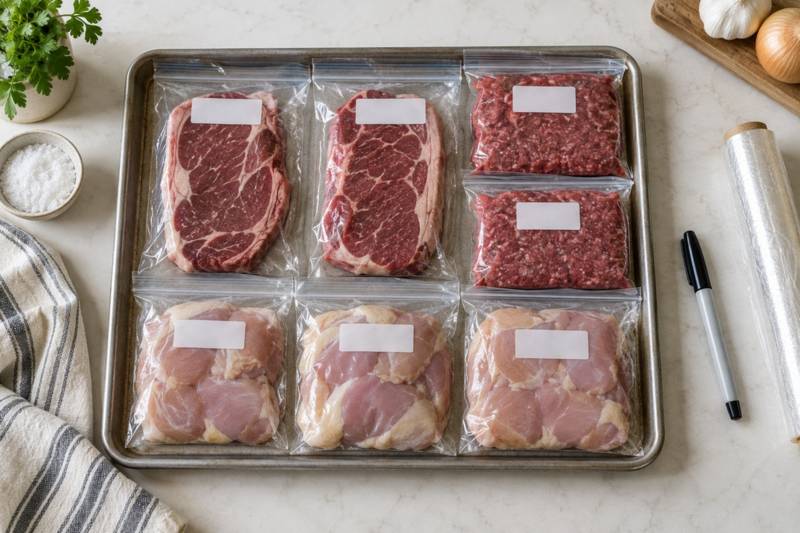
FSIS says it's safe to freeze meat and poultry in the store package, but that wrap lets air through. For anything you'll keep longer than a short while, overwrap the package with heavy-duty foil, freezer paper or a freezer bag, or rewrap the food yourself. Use materials sold for freezer use; NDSU Extension notes that ordinary waxed paper and reused milk or ice cream cartons don't hold up. Freeze unopened vacuum packages as they are.
Remove as much air as possible
Press air out of freezer bags before sealing, or use a vacuum sealer. Choose containers that match the amount of food so there's little empty space. Liquids such as soup need a little headspace because they expand as they freeze, but solid foods should be packed snugly. For ice cream, press plastic wrap or freezer paper directly onto the surface before putting the lid back on.
Keep the freezer at 0°F
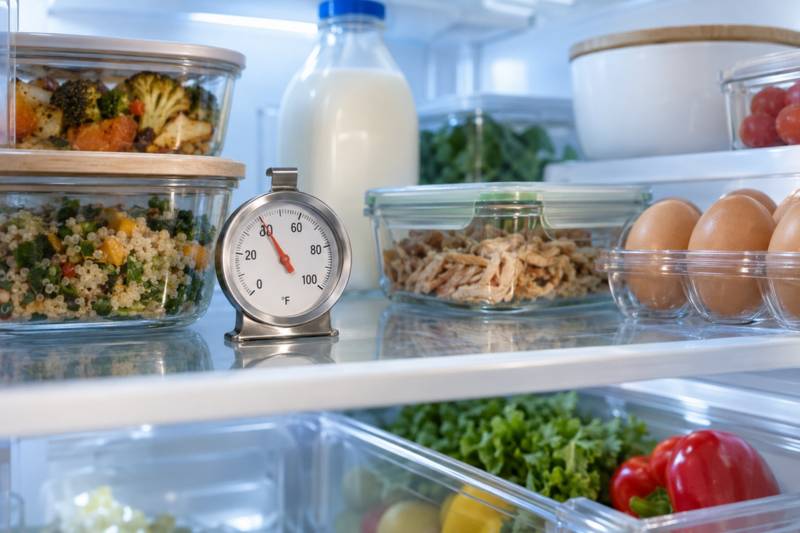
Set the freezer to 0°F (-18°C) or below and keep an appliance thermometer inside to check it, as FSIS recommends. Food freezes faster at that temperature and forms smaller ice crystals. Our guide to fridge and freezer temperatures covers settings and where to place the thermometer.
Avoid temperature swings
Each time the freezer warms and cools again, ice crystals grow and moisture moves out of the food. Keep the temperature steady, and use foods stored in the door or near the top of a chest freezer first, since those spots warm the most.
Freeze fast and don't overload
Cool cooked food before packaging it, then freeze it in a single layer with space around each package; FSIS says not to stack packages until they're frozen solid. Freeze small portions or flat, thin packages, which freeze faster. NDSU Extension recommends adding no more unfrozen food than will freeze within 24 hours, roughly 2 to 3 lb per cubic foot of freezer space. A packed-tight freezer also blocks the air circulation that keeps temperatures even.
Label, date and rotate
Write the food and date on every package and use older items first. Freezer burn builds with time, so following the quality times on our food storage charts is one of the simplest ways to avoid it. For step-by-step packaging, see how to freeze meat.
How to use freezer-burned food
Mild freezer burn is easy to deal with:
- Thaw it safely. Use the fridge, cold water or the microwave, never the counter. Our thawing guides give times by food.
- Trim the dry spots. FSIS says you can cut away freezer-burned portions before or after cooking. Trimming before cooking removes most of the stale taste.
- Cook as usual. Cook meat and poultry to safe temperatures, such as 165°F for chicken and 160°F for ground beef.
- Discard badly burned food for quality. If most of a piece is dry and discolored, FSIS and Iowa State University Extension suggest throwing it out, not because it's dangerous, but because it won't taste good.
For ice cream, scrape off the icy top layer. The rest underneath is often fine.
Questions people ask
Can freezer burn make you sick?
No. USDA FSIS says freezer burn doesn't make food unsafe; it only dries it out in spots. Illness comes from unsafe handling, such as thawing on the counter or undercooking, not from freezer burn.
Can you eat freezer burned meat?
Yes. Trim off the dry, discolored areas before or after cooking and cook the meat to its USDA safe minimum temperature. Heavily burned pieces are safe but may be too dry to enjoy.
Is freezer burned chicken safe to eat?
Yes, as long as it stayed frozen and you thaw it safely and cook it to 165°F. Cut away grayish-white leathery patches, which will otherwise cook up dry and tough.
Can you eat freezer burned ice cream?
Yes, it's safe, just icy and less creamy. Scrape off the crystallized layer, and next time press plastic wrap onto the surface before closing the carton.
How do you get rid of freezer burn taste?
You can't reverse it, but you can remove it: trim the affected surface before cooking. Using the rest in a dish where texture matters less, such as a soup or stew, also helps.
What causes freezer burn?
Moisture escaping from the food's surface in the cold and air reaching the dried spot. Loose or air-permeable wrapping, a warm or fluctuating freezer, and long storage all make it worse.