Eggs do go bad, but slowly. Refrigerated at 40°F or below, raw eggs in the shell keep 3 to 5 weeks, according to USDA, often past the date on the carton. To tell if an egg is bad, crack it into a bowl: an off smell or an unusual look means throw it out. The float test only shows age.
Key facts
- Raw shell eggs keep 3–5 weeks in the fridge at 40°F or below (USDA FSIS).
- A floating egg is old, not necessarily unsafe; its air cell has grown large enough to make it buoyant.
- Carton dates are about quality. A graded carton's "sell-by" date can be no more than 30 days after the pack date.
- Refrigerated eggs shouldn't sit out more than 2 hours.
- Cook eggs until the white and yolk are firm, and egg dishes to 160°F.
Do eggs go bad?
Yes, eggs can go bad, but a cold egg changes slowly. As an egg ages, moisture and carbon dioxide escape through the pores in the shell. FSIS explains that this makes the air cell at the large end of the egg grow larger. That's a quality change: an older egg is lower in quality, but it isn't automatically unsafe.
An egg is spoiled when it smells bad. Nebraska Extension notes that a spoiled egg has an unpleasant odor when you break it open, raw or cooked. USDA's Food Safety and Inspection Service (FSIS) says to crack a questionable egg into a bowl and check for an off odor or unusual appearance before using it.
Safety is a separate question from spoilage. An egg can smell and look normal and still carry Salmonella (more on that below), which is why cooking matters as much as freshness.
How long does it take for eggs to go bad in the fridge?
FSIS gives 3 to 5 weeks for raw eggs in the shell kept in the refrigerator. Nebraska Extension adds that this counts from the day you buy them, and that the "sell-by" date will usually pass during that time while the eggs are still safe to use. The FDA, aiming for best quality, suggests using eggs within 3 weeks.
| Egg | Fridge (40°F or below) | Freezer |
|---|---|---|
| Raw eggs in the shell | 3–5 weeks | Don't freeze in the shell |
| Raw whites or yolks | 2–4 days | Whites up to 12 months; yolks don't freeze well |
| Hard-boiled eggs | 1 week | Don't freeze |
| Egg dishes (quiche, casseroles) | 3–4 days | 2–3 months for best quality |
Where to keep eggs in the fridge
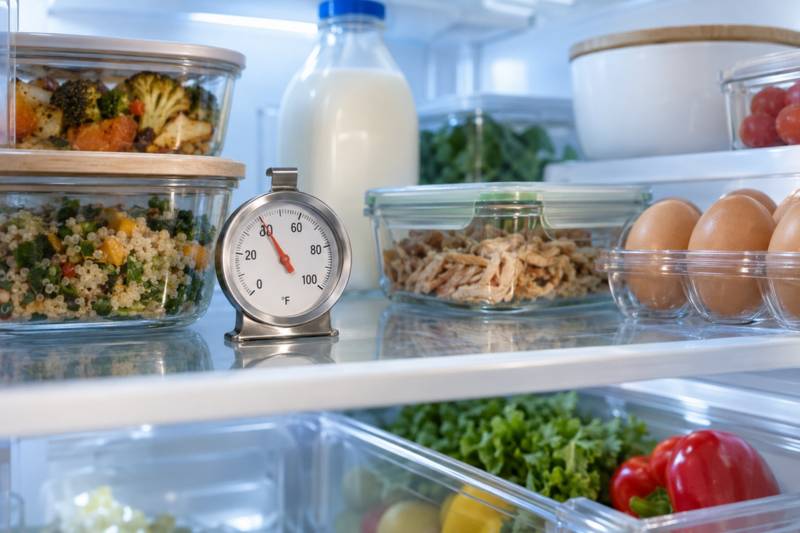
Store eggs in their original carton on a shelf in the main compartment, not in the door. FSIS says to put them in the coldest part of the fridge, and the FDA notes the door is warmer. Keeping the carton also keeps the pack date with the eggs. Check that your fridge is actually at 40°F or below; see what temperature a refrigerator should be.
Don't wash eggs before storing them. FSIS says USDA-graded eggs are already washed and sanitized at the plant, and washing at home can pull water into the egg through the shell's pores.
Do eggs go bad if left out?
In the US, eggs are sold refrigerated and should stay that way. FSIS says refrigerated eggs shouldn't be left out more than 2 hours. A cold egg that warms up can "sweat," and the moisture on the shell helps bacteria move into the egg; any Salmonella present can also multiply at room temperature. Cooked eggs and egg dishes follow the same limit, which the FDA drops to 1 hour above 90°F. Details for other foods are in how long food can sit out.
The egg float test: what it shows
To do the float test, gently set an egg in a bowl of cold water.
- It sinks: the air cell is still small, which points to a fresher egg.
- It floats: the air cell has grown large enough to keep the egg buoyant. FSIS and Nebraska Extension both say this means the egg is older and lower in quality, but it may still be perfectly safe to use.
The float test measures age, not safety. It can't detect Salmonella, so a fresh egg that sinks still needs proper cooking. Treat it as a quick sort, and crack any floater into a separate bowl and smell it before using it. If an egg smells off or looks unusual, throw it out.
Sell-by vs. expiration dates on eggs
FSIS says product dates are about quality, not safety, and federal rules don't require them on most foods (infant formula is the exception). For eggs, a "sell-by" or "EXP" date isn't federally required, but state egg laws may require one, and some states don't allow "sell-by" dates at all. Here's how to read a carton:
- Pack date: USDA-graded cartons carry a three-digit number for the day the eggs were packed, from 001 (January 1) to 365 (December 31). Nebraska Extension's example: 032 means February 1.
- Sell-by or EXP: on a graded carton, no more than 30 days after the pack date. It tells the store how long to display the eggs.
- Use-by or best-if-used-by: on graded eggs, no more than 45 days counting the pack date.
So eggs bought just before the sell-by date are still within their 3–5 week fridge window. Past that window, or if an egg smells bad, toss it.
Salmonella and cooking eggs safely
FSIS warns that eggs can carry Salmonella Enteritidis, sometimes on the inside, because bacteria can get in while the egg forms in the hen, before the shell is complete. You can't see, smell or float-test for it. The FDA says symptoms such as diarrhea, fever, cramps and vomiting usually start 12 to 72 hours after infection.
The fix is heat:
- Cook eggs until both the white and the yolk are firm (FSIS, FDA). Scrambled eggs shouldn't be runny.
- Cook casseroles, quiche and other egg dishes to 160°F, checked with a food thermometer. See safe temperatures for eggs and all cooking temperatures.
- For dishes served raw or undercooked, the FDA suggests in-shell pasteurized eggs or pasteurized egg products.
- Reheat leftover egg dishes to 165°F.
Infants and young children, older adults, pregnant people and anyone with a weakened immune system are at higher risk of serious illness, so they should stick to fully cooked eggs.
Questions people ask
Can eggs go bad in the refrigerator?
Yes, eventually. USDA says raw shell eggs keep 3 to 5 weeks in the fridge at 40°F or below; after that, quality drops and spoilage becomes more likely.
Are eggs good after the sell-by date?
Usually. Nebraska Extension says the sell-by date often passes during the 3 to 5 weeks eggs keep after purchase, and the eggs remain safe to use if kept cold.
Is it safe to eat an egg that floats?
A floating egg is old, not necessarily bad. Crack it into a separate bowl and throw it out if it smells off or looks unusual.
How do you know if a hard-boiled egg is bad?
Hard-boiled eggs keep 1 week in the fridge. Discard any that are older, that sat out more than 2 hours, or that smell off.
Can you freeze eggs?
Not in the shell. Crack and beat whole eggs before freezing; raw whites freeze for up to 12 months.