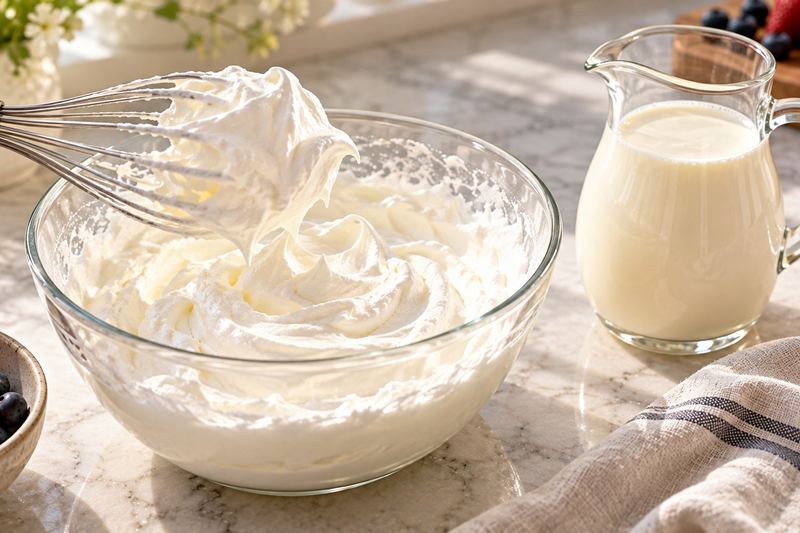
To make buttermilk, put 1 tablespoon of lemon juice or white vinegar in a liquid measuring cup, add milk to the 1-cup line, stir and let it stand 5 to 10 minutes until slightly thickened. This "sour milk" works in pancakes, biscuits and cakes because its acid reacts with baking soda.
Key facts
- Ratio: 1 tbsp lemon juice or white vinegar + milk to make 1 cup; rest 5–10 minutes.
- Cream of tartar works too: 1 3/4 tsp per 1 cup milk (Utah State University Extension).
- Greek yogurt and milk mixed 1:2 tasted closest to real buttermilk in King Arthur Baking's tests.
- Store-bought cultured buttermilk is milk soured by added bacteria, a product FDA defines in 21 CFR 131.112.
- Plain milk with no acid gave flat-tasting biscuits and a denser cake in King Arthur's tests.
How to make buttermilk from milk
You make buttermilk at home by souring regular milk with an acid. The result is often called "sour milk," and extension charts and recipe writers treat it as a stand-in for buttermilk in baking.
- Measure 1 tablespoon of lemon juice or white vinegar into a liquid measuring cup.
- Pour in milk until the liquid reaches the 1-cup line. Don't add a full cup of milk; the acid is part of the cup.
- Stir and let it stand 5 to 10 minutes. It will thicken very slightly and may look a little curdled. That's what you want.
- Stir again and use it as you would buttermilk.
Nebraska Extension and Utah State University Extension call for about 5 minutes of standing time. King Arthur Baking lets it sit 10 to 15 minutes, until it thickens slightly and curdles, so 5 to 10 minutes is a practical middle. Purdue Extension also gives 5 minutes.
How much lemon juice or vinegar to make buttermilk?
Use 1 tablespoon of acid per cup of buttermilk you need, and scale from there:
| Buttermilk needed | Lemon juice or white vinegar | Milk | Cream of tartar option |
|---|---|---|---|
| 1/2 cup (118 mL) | 1 1/2 tsp (1/2 tbsp) | Add to the 1/2-cup line | 7/8 tsp in 1/2 cup milk |
| 1 cup (237 mL) | 1 tbsp | Add to the 1-cup line | 1 3/4 tsp in 1 cup milk |
| 2 cups (473 mL) | 2 tbsp | Add to the 2-cup line | 3 1/2 tsp in 2 cups milk |
A tablespoon is 3 teaspoons, so 1/2 tablespoon is 1 1/2 teaspoons (see teaspoons in a tablespoon and mL in a cup).
Lemon juice or vinegar: which is better?
Either works. Extension charts from Nebraska, Utah State and Purdue list them interchangeably, and both supply the acid baking soda needs. Use white vinegar so the flavor stays neutral. If you're out of both, see our lemon juice substitutes and vinegar substitutes.
Other ways to make buttermilk at home
Vinegar and lemon juice are the fastest, but they aren't the only options. King Arthur Baking tested several in biscuits, pancakes and cake.
How to make buttermilk from yogurt
Mix plain Greek yogurt and milk 1:2, by volume. King Arthur Baking used Greek yogurt with 1% or skim milk; it was runner-up to real buttermilk in biscuits and tied it in pancakes, making it the best-tasting homemade option in their tests.
- 1/2 cup: 2 tbsp + 2 tsp Greek yogurt + 1/3 cup milk
- 1 cup: 1/3 cup Greek yogurt + 2/3 cup milk
- 2 cups: 2/3 cup Greek yogurt + 1 1/3 cups milk
Regular plain yogurt can replace buttermilk cup for cup; Utah State lists 1 cup plain yogurt for 1 cup buttermilk. If it's very thick, thin it with a little milk until it pours like buttermilk.
Sour cream thinned with milk
King Arthur Baking suggests sour cream thinned with milk or water until it has the consistency of heavy cream. No exact ratio was tested, so add liquid gradually. It's tangy and acidic like yogurt, so it works the same way in baking.
Milk and cream of tartar
Stir 1 3/4 teaspoons cream of tartar into 1 cup of milk. Utah State University Extension and King Arthur Baking both give this ratio. Shake or whisk well so the powder dissolves rather than clumping. It's handy when you have no lemons or vinegar. Learn more in what is cream of tartar.
Powdered buttermilk
Dried buttermilk powder is mixed with water following the package directions. King Arthur Baking says it performs as well as soured milk with leaveners, though it lacks the full flavor of fresh buttermilk. It keeps in the pantry, so it's useful if you bake with buttermilk only now and then.
| Method (for 1 cup) | How | Best for |
|---|---|---|
| Lemon juice or vinegar | 1 tbsp + milk to 1 cup; rest 5–10 min | Pancakes, cakes, quick breads |
| Greek yogurt + milk | 1/3 cup yogurt + 2/3 cup milk | Biscuits, pancakes; best flavor |
| Plain yogurt | 1 cup, thinned if very thick | Baking |
| Cream of tartar | 1 3/4 tsp + 1 cup milk | Baking without lemon or vinegar |
| Sour cream | Thin with milk or water to pourable | Baking in a pinch |
For a broader list and when each swap fails, see our buttermilk substitutes page.
Why homemade buttermilk works: acid and baking soda
Recipes use buttermilk for its acidity. When an acidic liquid meets baking soda, they react and release carbon dioxide, which lifts the batter. The acid also tenderizes gluten and adds tang. Sour milk, yogurt and cream of tartar all supply acid, which is why they work.
Regular milk alone doesn't. In King Arthur Baking's tests, plain milk made flat-tasting biscuits, lower pancakes and a darker, denser cake, because the baking soda had no acid to react with. If you must use plain milk in a soda-leavened recipe, Purdue Extension suggests replacing 1 cup buttermilk plus 1/2 teaspoon baking soda with 1 cup milk plus 2 extra teaspoons of baking powder. Our baking soda vs baking powder guide explains why.
How is buttermilk made? Cultured vs homemade
Store-bought buttermilk is cultured: milk that has been fermented with bacteria that sour and thicken it. FDA's standard for cultured milk (21 CFR 131.112) covers it, and allows the name "cultured buttermilk." King Arthur Baking notes that today's version is usually low-fat or skim milk inoculated with these cultures.
The original buttermilk was different: the liquid left behind after churning cream into butter. You can still see this if you over-whip heavy cream until it breaks into butter and liquid, as King Arthur Baking describes. That liquid is traditional buttermilk, but it isn't what modern recipes mean.
Homemade sour milk sits between the two. It's acidic enough for baking but thinner and less complex than cultured buttermilk. King Arthur recommends real buttermilk where it's the star, such as dressings or cold buttermilk soups.
Is buttermilk the same as heavy cream?
No. Heavy cream is sweet, unsoured and at least 36% milkfat under FDA rules. Cultured buttermilk is tangy and usually made from low-fat or skim milk. They don't substitute for each other. See heavy cream vs whipping cream for cream types.
Kefir vs buttermilk
Kefir is also a cultured milk, made with a different set of microbes; FDA's cultured milk standard names "kefir cultured milk" separately. It's tangy and pourable, and King Arthur Baking lists plain, unsweetened kefir as a buttermilk substitute.
How long does homemade buttermilk last?
Make homemade buttermilk when you need it and use it right away. If you have extra, cover it and refrigerate at 40°F or below, and treat it like the milk it came from: opened milk keeps about a week (see how long milk lasts). Like other dairy, it shouldn't sit out more than 2 hours (see how long food can sit out). King Arthur Baking freezes leftover buttermilk in 1/2-cup portions; it may separate when thawed but works fine in baking.
Questions people ask
How do you make buttermilk with vinegar?
Put 1 tablespoon white vinegar in a measuring cup, add milk to the 1-cup line, stir and let it stand 5 to 10 minutes before using.
How much lemon juice do you need to make buttermilk?
One tablespoon of lemon juice per cup, topped up with milk to 1 cup. For 1/2 cup, use 1 1/2 teaspoons; for 2 cups, use 2 tablespoons.
Is sour milk the same as buttermilk?
Not exactly. Sour milk is regular milk acidified with lemon juice or vinegar; buttermilk is cultured with bacteria. Sour milk works as a buttermilk substitute in baking.
Can you substitute regular milk for buttermilk?
Not on its own in recipes that use baking soda. Add an acid first, or swap in extra baking powder as Purdue Extension suggests.
How long should homemade buttermilk sit?
About 5 to 10 minutes. Extension charts say about 5 minutes, and King Arthur Baking lets it stand 10 to 15 minutes until slightly thickened.
Sources
- King Arthur Baking: Buttermilk substitute
- Nebraska Extension: Ingredient substitutions
- Utah State University Extension: Ingredient substitution (FN 255)
- eCFR (FDA): 21 CFR 131.112, Cultured milk
- King Arthur Baking: How to fix overwhipped cream
- Purdue Extension: Substitutions and equivalents in food ingredients (CFS-145-W)