One US stick of butter is 1/2 cup, which equals 8 tablespoons, 4 ounces or about 113 grams. Two sticks make 1 cup (227 g), and four sticks make 1 pound. The tablespoon lines printed on most wrappers let you cut exact amounts without a measuring cup.
Key facts
- 1 stick = 1/2 cup = 8 tbsp = 4 oz = 113 g (King Arthur Baking).
- 1 cup of butter = 2 sticks = 16 tbsp = 8 oz = 227 g.
- 1 pound of butter = 4 sticks = 2 cups = about 454 g.
- 1 tablespoon of butter weighs about 14.2 g (113.4 g ÷ 8).
- East Coast (Elgin) and West Coast sticks are shaped differently but each holds a quarter pound (Oklahoma State University).
How much is a stick of butter?
A standard US stick of butter is 1/2 cup, 8 tablespoons, 4 ounces or 113 grams. That's the figure King Arthur Baking uses in its ingredient weight chart, and it follows directly from the weight: 4 ounces at NIST's 28.34952 g per ounce is 113.4 g, so a cup (2 sticks) is about 227 g. These are the numbers we use across the site, including on our butter cups-to-grams page.
The reason it works out so neatly is packaging. Oklahoma State University's Food and Agricultural Products Center notes that US butter is mostly sold in 1/2-pound or 1-pound boxes, split into quarter-pound sticks. A quarter pound is 4 ounces, and 4 ounces of butter fills half a cup. A "bar of butter" in a recipe means the same thing as a stick.
How many tablespoons is a stick of butter?
One stick is 8 tablespoons. Half a stick is 4 tablespoons, and a quarter stick is 2 tablespoons. Our tablespoons in a stick of butter page has the quick answer, and tablespoons in a cup covers the 16-tablespoon cup it's based on.
How many cups is a stick of butter?
One stick is 1/2 cup. So 1 cup of butter is 2 sticks, 3/4 cup is 1 1/2 sticks, and 1/4 cup is half a stick. A stick is not 1 cup; that's a common mix-up that doubles the butter in a recipe.
Butter sticks to cups, tablespoons, ounces and grams
Use this chart to convert from 1/4 stick up to a full pound. Gram figures are rounded to the nearest gram from 113 g per stick and 227 g per cup.
| Sticks | Cups | Tablespoons | Ounces | Grams |
|---|---|---|---|---|
| 1/4 stick | 1/8 cup | 2 tbsp | 1 oz | 28 g |
| 1/2 stick | 1/4 cup | 4 tbsp | 2 oz | 57 g |
| 3/4 stick | 3/8 cup | 6 tbsp | 3 oz | 85 g |
| 1 stick | 1/2 cup | 8 tbsp | 4 oz | 113 g |
| 1 1/2 sticks | 3/4 cup | 12 tbsp | 6 oz | 170 g |
| 2 sticks | 1 cup | 16 tbsp | 8 oz | 227 g |
| 2 1/2 sticks | 1 1/4 cups | 20 tbsp | 10 oz | 284 g |
| 3 sticks | 1 1/2 cups | 24 tbsp | 12 oz | 340 g |
| 4 sticks (1 lb) | 2 cups | 32 tbsp | 16 oz | 454 g |
How many sticks is 1 cup, 3/4 cup or 1/2 cup of butter?
- 1 cup = 2 sticks (16 tbsp, 8 oz, 227 g)
- 3/4 cup = 1 1/2 sticks (12 tbsp, 6 oz, 170 g)
- 2/3 cup = 1 stick plus 2 2/3 tbsp (about 151 g)
- 1/2 cup = 1 stick (8 tbsp, 4 oz, 113 g)
- 1/3 cup = 5 1/3 tbsp, about 2/3 of a stick (about 76 g)
- 1/4 cup = 1/2 stick (4 tbsp, 2 oz, 57 g)
For thirds, the tablespoon lines on the wrapper get you closest: 5 tablespoons plus 1 teaspoon is 1/3 cup, since a tablespoon is 3 teaspoons (see teaspoons in a tablespoon).
How many sticks of butter are in a pound?
There are 4 sticks in a pound of US butter, which is 2 cups or about 454 grams. One stick is a quarter pound. NIST defines the avoirdupois pound as 453.5924 g, so 454 g is the rounded figure; see grams in a pound and ounces in a pound.
How much does a stick of butter weigh?
A stick of butter weighs 4 ounces, or about 113 grams. Using NIST's factor of 28.34952 g per ounce, 4 ounces is 113.4 g, which recipes round to 113 g. Two sticks come to 226.8 g, so you'll see 1 cup of butter listed as either 226 g or 227 g; the 1-gram difference doesn't matter in a recipe.
Smaller amounts, at about 14.2 g per tablespoon (one stick divided by 8):
- 1 tablespoon of butter = about 14 g
- 2 tablespoons = about 28 g (1 oz)
- 4 tablespoons = about 57 g
How to convert grams of butter to tablespoons
To turn grams of butter into tablespoons, divide by 14.2. That's handy for recipes from outside the US, which usually give butter by weight.
| Grams of butter | Tablespoons (approx.) | US sticks (approx.) |
|---|---|---|
| 25 g | 1 3/4 tbsp | about 1/4 stick |
| 50 g | 3 1/2 tbsp | a little under 1/2 stick |
| 75 g | 5 1/4 tbsp | about 2/3 stick |
| 100 g | 7 tbsp | a little under 1 stick |
| 125 g | 8 3/4 tbsp | 1 stick + 3/4 tbsp |
| 250 g | 17 1/2 tbsp | about 2 1/4 sticks |
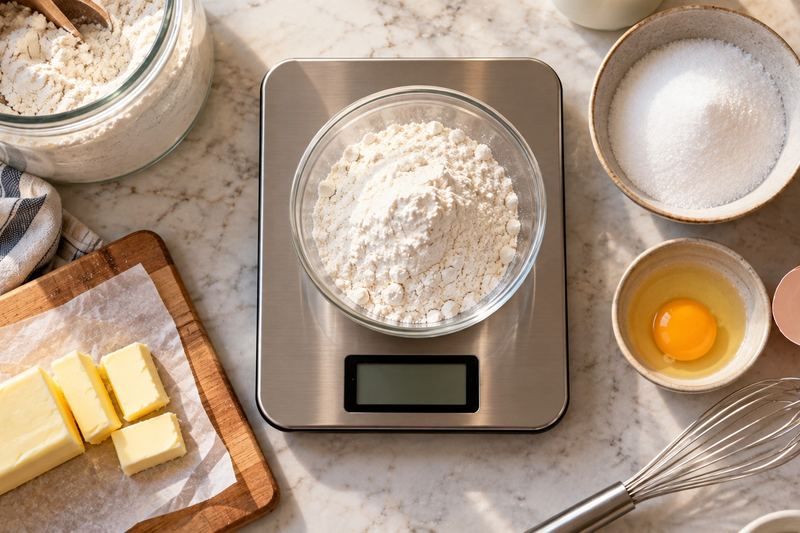
A kitchen scale is the most accurate way to measure butter by weight. For other ingredients, our cups to grams hub lists tested weights; peanut butter, for example, is much heavier per cup than butter (see peanut butter cups to grams).
How to use the markings on a butter wrapper
Most US butter wrappers are printed with tablespoon lines, which Oklahoma State University's FAPC notes is standard on quarter-pound sticks. Each line marks 1 tablespoon. To measure, set the stick on a cutting board with the wrapper on, line up a sharp knife with the mark you need, and slice straight down through the paper.
The lines are only as accurate as the wrapper's position on the stick, so for baking where precision matters, weigh the butter instead.
East Coast vs West Coast butter sticks
US butter comes in two stick shapes. Oklahoma State University describes the long, slim East Coast stick as the Elgin style and the short, stout West Coast stick as the Western style, sometimes nicknamed "stubbies." Both are quarter-pound sticks, so both hold 4 ounces, 8 tablespoons and 1/2 cup. Only the shape changes. That matters if you own a butter dish sized for one style, but not for any recipe.
Is melted butter measured the same as solid butter?
Yes, for most recipes. Melting doesn't change the weight: a stick weighs 113 g whether it's cold or melted. The volume is also close, so 1/2 cup of melted butter is roughly one stick. If a recipe says "1/2 cup butter, melted," melt one stick. If it says "1/2 cup melted butter," measuring after melting gives almost the same result. Weighing removes the question entirely.
Melted and solid butter aren't interchangeable in technique, though. Creaming cold or softened butter with sugar traps air, and cutting cold butter into flour makes flaky layers. Our butter substitutes page explains which swaps work for melted butter only.
How is butter sold in other countries?
Outside the US, butter is usually sold as a block labeled by its net weight in grams rather than in quarter-pound sticks. Check the package for the weight and convert with the gram table above. Composition is similar worldwide: USDA defines butter as at least 80% milkfat by weight, and the international Codex standard Oklahoma State cites sets the same 80% minimum with no more than 16% water.
Does salted or unsalted butter change the measurement?
No. Salted and unsalted sticks are the same size and weight: 1/2 cup, 8 tablespoons, 113 g. The only difference is the salt. If you bake with salted butter in a recipe written for unsalted, you may want to cut back slightly on added salt. For how long either kind keeps, see how long butter lasts.
Questions people ask
Is 1 stick of butter 1 cup?
No. One stick is 1/2 cup. You need 2 sticks for 1 cup of butter.
How many tablespoons are in a stick of butter?
There are 8 tablespoons in one US stick of butter. Half a stick is 4 tablespoons.
How many ounces is a stick of butter?
A stick of butter is 4 ounces by weight, or a quarter pound. That's about 113 grams.
How many grams is 1/2 cup of butter?
Half a cup of butter, or one stick, is about 113 grams. One full cup is about 227 grams.
How many tablespoons are in 1/4 cup of butter?
There are 4 tablespoons in 1/4 cup of butter, which is half a stick or about 57 grams.
How much is 2 1/2 sticks of butter in cups?
Two and a half sticks is 1 1/4 cups of butter, which is 20 tablespoons or about 284 grams.