Cream of tartar is potassium bitartrate, a dry, acidic white powder that forms as a byproduct of winemaking. Bakers use it to stabilize whipped egg whites (about 1/8 teaspoon per white), to keep sugar syrups from crystallizing, and as the acid that reacts with baking soda in homemade baking powder and snickerdoodles.
Key facts
- FDA identifies cream of tartar as potassium bitartrate (potassium acid tartrate), obtained as a byproduct of wine manufacture.
- It's an acid salt, so it reacts with baking soda to make carbon dioxide.
- Typical use in meringue: a pinch to 1/8 tsp per egg white (King Arthur Baking).
- Homemade baking powder: 1/4 tsp baking soda + 1/2 tsp cream of tartar = 1 tsp baking powder.
- Despite the name, it contains no cream or dairy, and it has nothing to do with tartar sauce.
What is cream of tartar?
Cream of tartar is potassium bitartrate, the potassium acid salt of tartaric acid. FDA's regulation for the ingredient (21 CFR 184.1077) gives it three names, potassium acid tartrate, potassium bitartrate and cream of tartar, and lists it as generally recognized as safe for baked goods, frostings, candies, jams and jellies, puddings and gelatins. In stores it's sold as a fine white powder in small jars, usually in the spice aisle.
It's an acid, which is the key to everything it does in the kitchen. King Arthur Baking calls it an "acid salt," and it behaves like a dry, flavorless-in-small-amounts version of lemon juice or vinegar that won't add liquid to a recipe.
What is cream of tartar made from, and where does it come from?
Cream of tartar comes from wine. FDA describes it as a byproduct of wine manufacture, and King Arthur Baking explains that it crystallizes out of wine during fermentation and collects inside the barrels. Those crystal deposits are purified into the powder you buy, which is why the jar holds a fine white powder rather than anything you'd recognize from a winery.
Is cream of tartar the same as tartar sauce?
No. Tartar sauce is a creamy condiment served with fish. Cream of tartar is a dry baking acid. They share part of a name and nothing else, so don't swap one for the other. If you searched "cream of tartar tartar" to sort this out, this is the answer.
What does cream of tartar do in baking?
Cream of tartar does four main jobs, all because it's an acid:
- Stabilizes whipped egg whites for meringue, pavlova, chiffon cake and soufflé pancakes.
- Prevents sugar crystallization in syrups, candies and caramel, so they stay smooth instead of turning grainy.
- Acts as the acid in baking powder, reacting with baking soda to make the gas that lifts a batter.
- Shapes snickerdoodles, where it pairs with baking soda for their soft, melt-in-the-mouth texture.
FDA's list of approved functions is longer (it includes leavening agent, pH control agent, stabilizer and thickener), but those four cover nearly every home recipe.
How does cream of tartar stabilize egg whites?
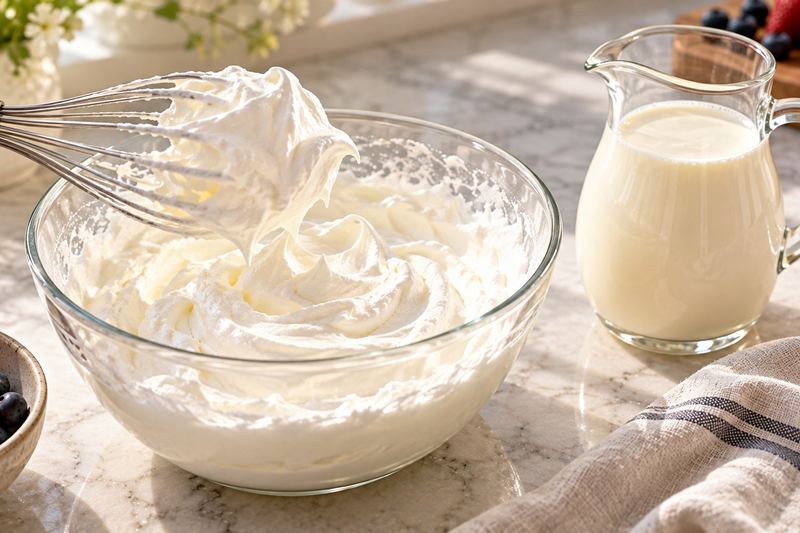
Cream of tartar makes whipped egg whites stronger and less likely to weep or collapse by lowering their pH. When you whip whites, their proteins unfold and link into a network that holds air bubbles and water. America's Test Kitchen explains that acid slows the formation of sulfur bonds between those proteins, so the network doesn't tighten too far and squeeze out moisture. In its test, a meringue made without cream of tartar developed beads of liquid after chilling, while the one with it held.
King Arthur Baking adds that whites will still whip to stiff peaks without it; cream of tartar just makes the foam steadier, so it's worth adding when a recipe calls for it.
How much cream of tartar per egg white?
Use a pinch to 1/8 teaspoon per egg white. King Arthur Baking gives that range, and America's Test Kitchen uses 1/2 teaspoon for a four-white meringue, which works out to the same 1/8 teaspoon each.
| Egg whites | Cream of tartar |
|---|---|
| 1 white | A pinch to 1/8 tsp |
| 2 whites | 1/4 tsp |
| 3 whites | 3/8 tsp (1/4 tsp + 1/8 tsp) |
| 4 whites | 1/2 tsp |
| 6 whites | 3/4 tsp |
| 8 whites | 1 tsp |
More isn't better. King Arthur reports that too much gives a metallic, tinny taste, and a test batch of soufflé pancakes made with a full teaspoon came out poorly. Sprinkle it over the whites at the start of whipping, as Iowa State University's food preparation lab manual does for meringue. For food safety with raw or lightly cooked whites, see is it safe to eat raw eggs; leftover yolks and whites keep in the fridge, too (see how long eggs last and how long egg whites last).
Can you make meringue without cream of tartar?
Yes. Whites whip without it, though the foam is a little less stable. Lemon juice or white vinegar can stand in, since they're also acids. Our cream of tartar substitutes page has the ratios, so we don't repeat them here.
How do you use cream of tartar with baking soda?
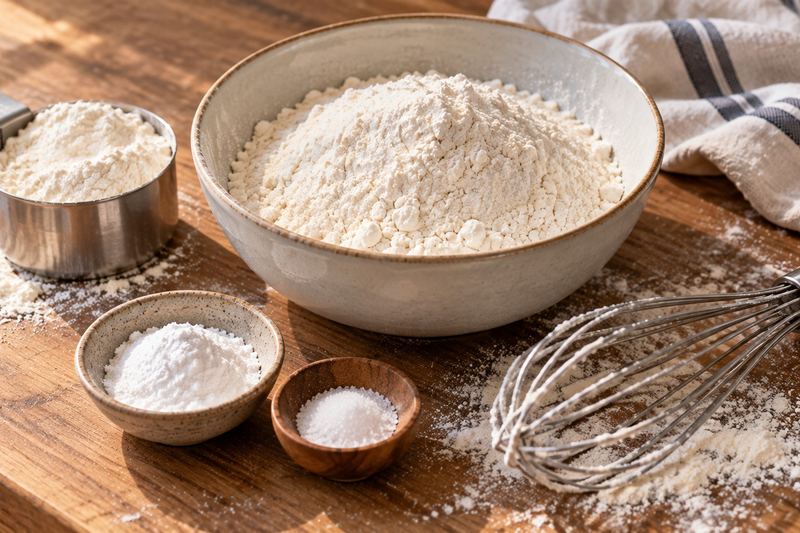
Mixed with baking soda, cream of tartar makes a homemade baking powder. King Arthur Baking's formula for 1 teaspoon of baking powder is 1/4 teaspoon baking soda + 1/2 teaspoon cream of tartar, plus 1/4 teaspoon cornstarch if you want to store a batch. That's a 2-to-1 ratio of cream of tartar to soda.
Unlike store-bought double-acting powder, this mix starts reacting the moment it gets wet, so bake right away. Our guide to baking soda vs baking powder explains the chemistry, and the baking powder substitutes page lists other options.
Why do snickerdoodles use cream of tartar?
Classic snickerdoodles use cream of tartar with baking soda as their leavening. King Arthur Baking's recipe calls for 2 teaspoons cream of tartar and 1 teaspoon baking soda, and credits cream of tartar (with shortening) for the cookies' melt-in-your-mouth texture. If you're out, the same recipe says to replace both with 2 teaspoons of baking powder in total, not 3.
Cream of tartar vs baking soda
They're opposites. Baking soda is a base; cream of tartar is an acid. Neither one leavens much on its own, but together, with moisture, they make carbon dioxide. You can't swap one for the other; if you're short on soda, see baking soda substitutes.
Does cream of tartar go bad?
Cream of tartar is a dry, shelf-stable powder, and none of the agency or extension storage charts we checked give it a safety deadline. What matters is keeping it dry. Store it tightly capped in a cool, dry cupboard away from the stove's steam, and go by the date on the jar for best quality. If it has absorbed moisture and hardened into clumps, or picked up off odors, replace it. Use a dry measuring spoon each time; see tablespoon vs teaspoon for small-measure tips.
Is cream of tartar gluten free and dairy free?
Pure cream of tartar is a single compound, potassium bitartrate, made from wine byproducts, so it contains no milk and no wheat. The "cream" in the name has nothing to do with dairy. If you're avoiding gluten for medical reasons, check the jar's label for any allergen or facility statement, as you would with any packaged spice.
Questions people ask
Is cream of tartar an acid?
Yes. It's potassium bitartrate, an acid salt of tartaric acid, which is why it reacts with baking soda and stabilizes egg whites.
What does cream of tartar taste like?
In the small amounts recipes use, you won't notice it. Too much gives a sour, metallic, tinny taste, according to King Arthur Baking.
Do you need cream of tartar for meringue?
No, but it helps. Egg whites whip without it; a pinch to 1/8 teaspoon per white makes the foam steadier and less likely to weep.
Can you make cream of tartar at home?
Not practically. It's a purified byproduct of winemaking. For recipes that need it, use the swaps on our cream of tartar substitutes page.
What is the ratio of baking soda to cream of tartar for baking powder?
Use 1 part baking soda to 2 parts cream of tartar: 1/4 teaspoon soda plus 1/2 teaspoon cream of tartar makes 1 teaspoon baking powder.
Sources
- eCFR (FDA): 21 CFR 184.1077, Potassium acid tartrate
- King Arthur Baking: What is cream of tartar?
- America's Test Kitchen: The importance of cream of tartar
- King Arthur Baking: The difference between baking soda and baking powder, plus substitutions
- King Arthur Baking: Snickerdoodles
- Iowa State University: Food Preparation Lab, Introduction to foam products